Introduction:
EFG Hermes is a leading investment bank offering services including securities brokerage, investment banking, research, asset management and private equity. As responsible investment is part of EFG Hermes’ corporate strategy, EFG Hermes is committed to integrating Environmental, .Social and Governance principles into its investment approach and practice, wherever applicableEFG Hermes Private Equity is a regional leader with a track record in supporting and actively helping turn- around businesses to achieve growth targets and create value for limited partners. The team’s experience spans more than two decades and a diversified set of sectors, including education, healthcare, infrastructure, .tourism and real estate, financial services, industrials, oil and gas, food and agribusiness, FMCG and retail
Purpose, oversight, and scope of policy:
This Policy lays out EFG Hermes Private Equity’s commitment and approach to integrating environmental, social and governance (“ESG”) factors into investment decisions and active ownership processes and practices.
The objective of this Policy is to bring leading practice in integrating ESG factors into EFG Hermes Private Equity day-to-day operations and provides further guidance and details for the implementation of the EFG Hermes Group’s ESG Policy to the Private Equity activities. This will enable the Private Equity team to lead by example amongst its peers by maintaining the highest standard in its investment approach.
This policy is approved by the EFG Hermes Private Equity Leadership Team and applies to all EFG Hermes Private Equity activities. The Private Equity Leadership team exercises oversight and is accountable for responsible investment practices and integration of material ESG factors into investment decision-making.
Commitment:
EFG Hermes Private Equity believes that its focus on investing in renewable energy generation, healthcare and education has a significant and positive role to play in supporting decarbonisation, economic growth and social prosperity, and therefore in contributing to the global sustainable development agenda, as set out by the United Nations Sustainable Development Goals.
EFG Hermes Private Equity is committed to integrating material ESG considerations into its investment processes with a view that it can enhance financial performance of its investment over the medium and long-term and create long-term value to its investors.
EFG Hermes is a signatory of the UN Principles for Responsible Investment, which commits EFG Hermes and its business lines, including Private Equity to the following principles:
1.We will incorporate ESG issues into investment analysis and decision-making processes.
2.We will be active owners and incorporate ESG issues into our ownership policies and practices.
3.We will seek appropriate disclosure on ESG issues by the entities in which we invest.
4.We will promote acceptance and implementation of the principles within the investment industry.
5.We will work together to enhance our effectiveness in implementing the principles.
6.We will each [PRI signatory] report on our activities and progress towards implementing the principles.
EFG Hermes Private Equity recognises that the implementation of these Principles will result in better outcomes for its investors and society at large.
ESG Integration into investments:
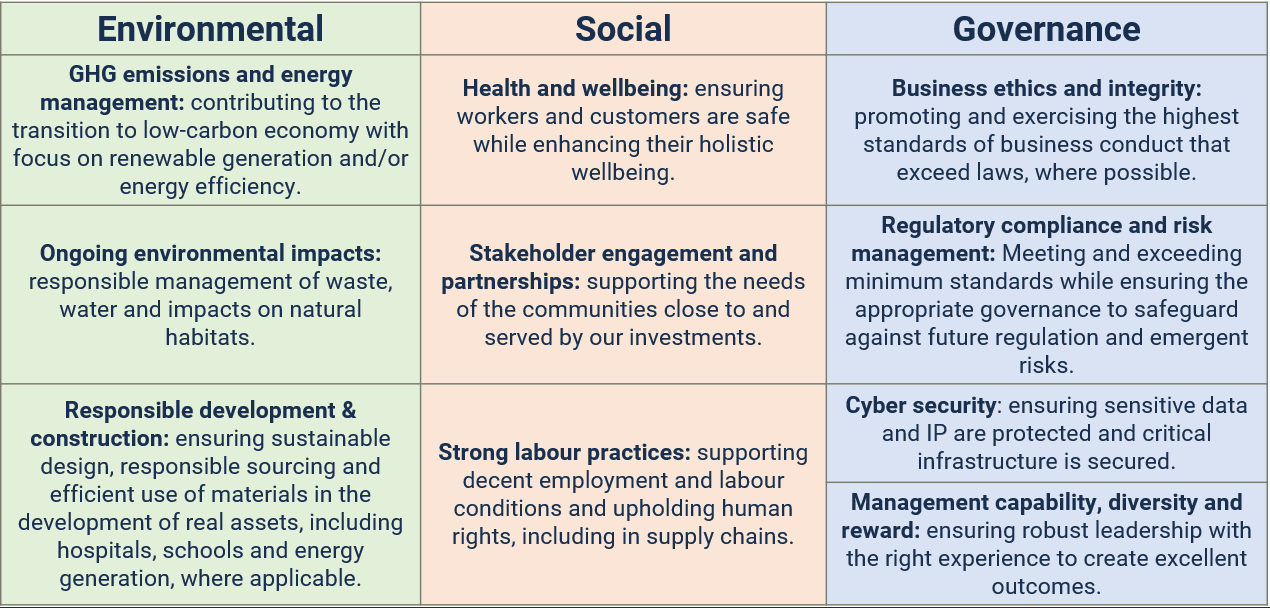
EFG Hermes Private Equity takes ESG factors into account at all stages during the investment cycle, including the initial screening, due diligence, decision making, active ownership and exit, where the structure enables such involvement. To allow for an effective and consistent identification and management of material risks and opportunities, while providing the flexibility to concentrate on what matters most to individual deal or investee company, EFG Hermes has developed an ESG Framework of common areas across the three verticals of renewable energy generation, healthcare, and education.
EFG Hermes Private Equity ESG Framework:
Prior to investing:
EFG Hermes Private Equity investment professionals conduct initial screening for each potential investment before a formal investment case is developed. The process consists of an initial assessment against the EFG Hermes Exclusionary Criteria (Appendix 1), which includes a short desktop review and headline engagement with the potential investee company’s management and/or owners.
Once, and if, the potential investment has passed the initial screening, it is subject to a thorough due diligence, led by the Private Equity investment professionals and external specialist advisors, when determined necessary. As part of this process, all potential investments are assessed against a standard set of criteria for each vertical under the ESG Framework.
The due diligence process provides valuable insight that helps the EFG Hermes Private Equity team form an informed opinion as to whether to proceed with the investment, and if so how to structure the transaction and what improvements may need to be implemented post acquisition. To that effect, the Private Equity Investment Committee papers for each potential investment include an ESG scorecard that summarises the outcomes of the ESG due diligence with an assigned score for each of the ESG Framework focus areas; and highlights any red flags and areas of concern. The score ratings are on a 1-4 scale, where 4 = Consistent poor practices, high risk, and 1= Strong practices, low risk. Potential mitigation measures are considered based on the level of risk and where the investment is scored the highest level of risk, these recommendations are referred to the EFG Hermes Executive Committee for an active discussion before proceeding with the deal.
Post investment:
EFG Hermes Private Equity believes that it can influence the enhancement of ESG practices and performance of investee companies the most post acquisition. This is also aligned with the firm’s belief in actively exercising its shareholder and governance rights to protect the long-term interests of its investors. To that end, EFG Hermes Private Equity seeks to take a director position on the board of its investee companies and to encourage the management teams of investee companies to commit to ESG improvement. Every investee company’s annual expenditure plan should allocate financial resources to support the implementation of ESG, using appropriate means such as staff training and development, or consultation with external specialists.
The Private Equity investment professionals shall be proactive in integrating ESG within investee companies by assisting the companies in developing mitigation plans to address their material ESG related risks and opportunities for value creation.
The ESG practices and performance of all investee companies are monitored annually through a standardised reporting process. The outcomes help inform further areas of engagement and improvement and enable the Private Equity team to share best practice across the portfolio.
In cases where EFG Hermes Private Equity has limited ability to control the integration of ESG factors in investee companies, or in circumstances where it is a minority shareholder, the fund manager, to its ability, should encourage investee companies to consider relevant ESG-related principles and standards. The fund manager will try to reserve the right to be consulted on ESG matters, so that EFG Hermes Private Equity is able to protect and enhance value through the structured understanding of ESG risks.
Transparency and disclosure:
EFG Hermes Private Equity believes in the benefits of transparency and is committed to continuously improving its ESG-related disclosures and communication to its investors and other key stakeholders. EFG Hermes Private Equity already supplies information needed for the overall UN PRI disclosures summaries at EFG Hermes level.
EFG Hermes Private Equity provides periodic reports (annual or semi-annual) to its investors with operational and financial performance of portfolio companies and commentary on major events and developments.
Training and appraisals:
Training on sustainability, including ESG factors, is provided to all EFG Hermes Private Equity staff annually. Additional advanced training, with a focus on ESG integration, should be provided to select investment professionals based on the requirements of the business. All investment professionals are encouraged to attend industry events and pursue additional learning on ESG topics. The degree of ESG integration within the Private Equity business line is considered during annual performance appraisals of the department head by the senior management of EFG Hermes.
Appendix 1
EFG Hermes Exclusionary Criteria
The criteria seek to exclude investment on three levels:
1. Country Exclusion: exclude investing in companies that are registered in and/or derive more than 30% of total revenue from activities in countries that are subject to sanctions i.e. economic or financial sanctions or trade embargoes imposed, administered or enforced from time to time by one or more Sanctions Authorities1,
2. Company Exclusion: exclude companies that have a history of persistent and serious violations of one or more Principles of the U.N. Global Compact and have not implemented any measures to reduce the risks for further violations. For companies that fall under this criterion, we review their practices as part of our annual universe screening and would allow a company to become part of the investment universe should we see significant progress towards rectifying the original instances that excluded them in the first instance, and
3. Sector or activity Exclusion: exclude investments in certain sectors based on their substantial long-term ESG tail-risks and our internal standards as a responsible investor. Unless specifically noted in terms of revenue threshold (in parentheses), these sectors are automatically excluded from our investment universe:
Production or distribution of alcoholic beverages (5%);
Production of, or trade in, any product or activity deemed illegal under applicable local or national laws or regulations or subject to internationally agreed phase-outs or bans as defined in global conventions and agreements such as certain:
- hazardous chemicals, pharmaceuticals, pesticides and wastes,2
- ozone depleting substances;3
- endangered or protected wildlife or wildlife products;4 and
- unsustainable fishing methods such as blast fishing and drift net fishing in the marine environment using nets in excess of 2.5 kilometres in length;
Production of, or trade in, arms including but not limited to cluster munitions, anti-personnel mines, biological weapons, chemical weapons, depleted uranium munitions and non-detectable fragments, incendiary and blinding weapons, primarily designated for military purposes;
Production of, use of, or trade in, unbonded asbestos fibres. This does not apply to purchase and use of bonded asbestos cement sheeting where the asbestos content is less than 20%.;
Production of, or trade in, radioactive materials;5 or
Gambling, gaming casinos and equivalent enterprises (5%)
Adult entertainment including prostitution and pornography.
Coal Mining (30%)6
1 Sanctions Authority could be and not limited to the U.S. Govt, U.N. Security Council, European Union and the U.K. Treasury. Our Fixed Income strategies may deploy additional country exclusion criteria based on the Fund for Peace’s Fragile State Index.
2 As specified in the 2004 Stockholm Convention on Persistent Organic Pollutants (“POPs”), see www.pops.int; the 2004 Rotterdam Convention on the Prior Informed Consent Procedure for Certain Hazardous Chemicals and Pesticides in International Trade, see www.pic.int; the 1992 Basel Convention on the Control of Transboundary Movements of Hazardous Wastes and their Disposal, see www.basel.int and WHO Recommended Classification of Pesticides by Hazard Class Ia (extremely hazardous); or Ib (highly hazardous) www.who.int/ipcs/publications/pesticides_hazard/en/; as may be amended from time to time.
3 As specified in the 1999 Montreal Protocol on Substances that Deplete the Ozone Layer, see www.ozone.unep.org, as may be amended from time to time
4 As covered in the 1975 Convention on International Trade in Endangered Species or Wild Flora and Fauna (“CITES”), see www.cites.org, as may be amended from time to time.
5 This does not apply to purchase of medical equipment, quality control (measurement) equipment and any equipment in which the radioactive source could reasonably be considered to be trivial or adequately shielded.
6 Exclude all companies that derive more than 30% of their revenues from coal mining
We use cookies to collect information about how you use our website. And we use the information derived from such cookies to ensure the functionality of our website and to enhance our services.
